Page first published on April 24, 2022
See also War in Ukraine
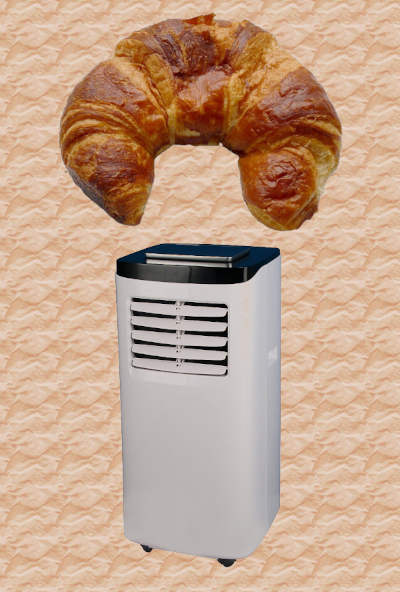
In the war that, unfortunately, is unfolding in Ukraine, as in all wars, beyond the battles waged on the ground, there's also the propaganda battle. Let's take a cue from a recent, much-discussed episode: on April 6, Prime Minister Draghi uttered the famous phrase, "Do we prefer peace or air conditioning? This is the question we must ask ourselves." There have been endless discussions on the topic, and this website is certainly very late to the game, but those who run it have other things in life and, in any case, prefer that discussions be conducted calmly and with due time—precisely the opposite of what the contemporary world, based on immediate reactions to words and events, would suggest.
Let's analyze the sentence in detail, to understand its various meanings.
top of pageLet's start by talking about the air conditioning half of the sentence by examining the real problem.
The underlying issue is a possible embargo on energy supplies from Russia. Italy is notoriously heavily dependent on Russian supplies of oil and natural gas. A potential embargo would cause significant problems. Italy has modest domestic production, completely insufficient for its needs and now declining, given that it has chosen not to further exploit the reserves we do have. We will have to return to this issue, but let's focus on managing the current situation.
Regarding oil, it must be considered that it arrives primarily by ship, which allows considerable flexibility in choosing the country of origin. Naturally, there remain the issues of resource availability and price, as well as the availability of tankers. An oil embargo on Russia would be costly and could make it difficult for us to even procure the necessary quantities on the international market, assuming supplies from other countries currently under sanctions, such as Iran, are not unblocked.
The situation is much more critical for gas. ARERA data on gas origins can be found here . Most gas arrives in Italy via pipelines. The ability to import it by ship is tied to the availability of regasification facilities, because natural gas can only be transported by ship in a liquefied form at -162°C (which reduces its volume 600-fold, making the tank sizes reasonable for the quantity of gas to be transported) on special ships called methane tankers. A regasification terminal, or more simply a regasification facility, is used to unload the liquefied gas from the ship, store it locally to ensure uninterrupted supply to the grid, and then regasify it and compress it to grid pressure to allow its transport and distribution within the national grid.
I understand that there are only three plants of this type operating in Italy, only one of which is large (Adriatic LNG, an offshore facility off the mouth of the Po River). These plants are all already operating close to their maximum capacity, which in total is less than a third of the amount of gas we import from Russia. Therefore, to replace Russian gas with liquefied natural gas, we would need to multiply our regasification capacity by four.
Italy has few regasification plants, essentially because of the NIMBY (Not In My Backyard) effect: every time a plan is made to build one, a "no-regasification" committee is formed, local institutions are influenced, the committee appeals to the courts, sometimes the Superintendence of Fine Arts intervenes, and in the end, nothing comes to fruition. See also the article "Nimbya" on this site .
In any case, there's also a shortage of LNG carriers, and the price of liquefied gas is much higher than what Russia charges us. The United States claims it can supply us with the gas we need, but that's not true; its availability isn't sufficient. Qatar could, but the price remains to be seen.
In short, most of our gas reaches us via pipelines, which are fixed installations and only connect us to certain suppliers. A potential increase in non-Russian supplies can only occur via pipeline, and in the short term. A new pipeline, TAP, recently entered service, also opposed by NIMBY groups but ultimately built because international political pressure in its favor was too strong (let's skip over that because there would be reason to discuss it at length). It connects us to Azerbaijan's wells via the Balkans and Turkey, but it doesn't allow for further increases in the short term, although its expansion is already being planned. It remains to be seen how much gas Azerbaijan can supply.
Another source is the North Sea, essentially the Netherlands, but its deposits are depleting. Only North Africa remains, essentially Algeria, given the situation in Libya. Moreover, the latter's disastrous situation was caused by the destabilization of the Gaddafi regime and his assassination, spearheaded by former French President Sarkozy and French circles.
However, Algeria, due to its own problems, cannot increase its gas supplies sufficiently. It can only replace a small portion of Russia's supply within a reasonable timeframe.
Now, natural gas is the main energy source for Italy: about half of the electricity is produced with gas (ARERA data) , which is then essential for industry, domestic heating and other purposes - here you can find the data on its use .
It can be rightly argued that Italy's dependence on gas is excessive and that it should be replaced with other sources, particularly renewables, to reduce greenhouse gas emissions and secure the future. But the time required for this replacement is measured in decades. In addition to the technical timescales, any solution is always burdened by the NIMBY effect: every type of plant, including those generating electricity from sources like solar and wind, is subject to opposition from the "no this," "no that," and "no everything." Indeed, the time required to obtain authorization for any energy infrastructure in Italy can reach 10-15 years, assuming it ever arrives. This applies, as I said, to renewable energy plants as well.
In short, Russian gas is irreplaceable, except over a very long timescale (several years), which is necessary to build regasification plants and pipelines, for alternative suppliers to equip themselves to increase their production, or to make the transition to other energy sources.
Ultimately, it's not about having working air conditioners but about ensuring an essential part of the energy the nation needs .
top of pageThe other part of the claim is that peace can be achieved by implementing an embargo on energy supplies from Russia.
We can't rely on objective data here, but we must think about the issue. We might almost say it's unnecessary, as we've already shown that we can't give up Russia's energy supplies. But for the sake of completeness, let's delve deeper into this aspect of the conflict.
To be precise, peace is only a desired outcome. The concrete measure would be an embargo, which by its very nature is an act of economic warfare, not a peaceful one. We're talking about fighting alongside Ukraine, not militarily, but economically. The outcome cannot be taken for granted.
I've seen an objection to the nature of sanctions and embargoes, arguing that since in a free market you can buy from whomever you choose, deciding not to buy from a certain supplier isn't a hostile act but simply a choice. But this isn't true at all: sanctions and embargoes are obligations imposed by political authorities on economic operators, thus limitations on the free market. The term "free market" means buying and selling based on purely economic considerations: the moment political or even ethical considerations enter, we leave the free market and enter another sphere, one that free marketers abhor: political control over the economy. If I have to consult sanctions laws and guidelines when deciding who to buy from, I'm in the exact opposite of a free market.
Calling the energy embargo "peace" is completely incorrect: on the contrary, it is an act of economic warfare. That it can lead to peace is a political assertion, certainly highly debatable. It can reasonably be argued that in the event of further acts of hostility, Russia would in turn further escalate the violence of its intervention, bringing even more serious humanitarian consequences. Peace is achieved by lowering the level of conflict, not raising it. Raising it means aiming not for peace but for victory, therefore entering the war as a belligerent .
In conclusion, the alternative to "working air conditioners" is not peace but war.
top of pageReconsidering the sentence: "Do we prefer peace or the air conditioning on?", based on what we have explained above, we can say that:
The first rhetorical trick lies in the inversion of terms: it is assumed that by raising the level of conflict, Russia can be persuaded to surrender, and that a further act of hostility toward it can therefore lead to peace. In short, the aim is to force Russia to surrender through hostile acts, namely war. The outcome is uncertain, but the act itself is hostile, so we are talking about war, not peace. Talking about peace is a ruse to justify one's actions—precisely what Putin himself is doing, claiming to defend the legitimate interests of ethnically Russian populations against Nazi-fascist forces (Ukrainian nationalists, ideally descendants of Stepan Bandera) who must be forced to surrender, and refusing to call what he is doing a war.
The second trick is to talk about air conditioners, implying that they're a luxury that can be done without. We've seen that it's not about giving up air conditioners, but rather an essential part of the nation's energy supply, with evidently very serious consequences. These things happen when you're at war, and in fact, they're asking us to wage (economic) war by accepting very serious consequences that are misleadingly portrayed as small sacrifices.
I would also add that air conditioning isn't a luxury, but in many cases, a necessity. In a modern office building, it's impossible to live without air conditioning in the summer; moreover, it's often impossible to even open the windows. And then there are hospitals and the homes of those at risk of health problems when temperatures are too high. Heat kills the sick and the elderly.
In conclusion, if we translate the phrase into its true meaning, we are asking ourselves: "Do we want to go to war or not, accepting all the grave consequences that come with it?"
When I heard the original phrase, I was reminded of what is attributed to Queen Marie Antoinette of France, wife of Louis XVI, on the eve of the French Revolution: "The people have no bread? Let them eat brioche." The parallel is between air conditioners (brioche) and the nation's energy needs (bread).
What I find unacceptable is the contemptuous attitude of those who employ rhetorical devices that border on outright falsehood. The head of government of a democratic country has a moral duty to tell the truth to its citizens, not to utter catchy phrases that demonstrate substantial contempt for the listener. For example, saying, "We must make grave sacrifices to fight alongside Ukraine. Are you ready to do so?"
In a democracy, the answer to this type of question falls, at least ideally, to the citizens, who must be properly informed about the choice to be made. Formally, in the Italian Republic, this falls to Parliament, as it represents the citizens, but it cannot avoid providing them with adequate information.
In short, we're dealing with pure propaganda, because it's unthinkable that the Prime Minister doesn't know the true nature of the issue. We're despised and mocked.
top of pageNow that I have translated the question into the correct terms, I will give my answer separately: no, the way to achieve peace is not to worsen the war.
There are constant attempts to escalate the conflict by providing more weapons to Ukraine and introducing ever new sanctions. This means aiming for Russia's total defeat, a war objective. Peace would be the consequence of Russia's surrender, which is the true purpose of these actions.
My position is that peace must be sought through serious negotiations, which also take into account the Russian point of view. Raising the level of conflict would mean prolonging active hostilities, with all the consequences that this entails for the Ukrainian people and the world. Added to this is the real risk of open war between NATO and Russia, which would entail a huge tragedy for the entire world, endangering humanity itself.
President Putin has been demonized and called a criminal, but he is no more or less so than all the leaders who have started wars, a list that includes many American presidents and their allies, including some Italian heads of government. For example, see this analysis of the Kosovo war . If we want peace, we must come to terms with the Russia we face. The alternative is not to want peace but total war, which by definition aims at the complete subjugation of the enemy (see "On War" by Karl von Clausewitz).
Indeed, the United States always conceives wars as total, propagandistically portraying the enemy of the moment as a criminal to be destroyed. The ally of the moment, or America itself, on the other hand, can commit the most terrible acts, but is not a criminal. In fact, the United States has never joined the International Criminal Court for War Crimes—otherwise, it could be tried. It wasn't long ago that they abandoned Afghanistan after invading and occupying it for twenty years, only to then flee, leaving it to the "criminals" they had previously held, with whom they even made a deal. Everyone should remember that during the invasion, civilian massacres due to indiscriminate bombing were frequent, and that twenty years of guerrilla warfare followed, concluding precisely with the country being returned to the original regime they were trying to overthrow.
Indeed, America and its allies have caused or attempted to cause the collapse of various regimes in recent years, always labeled criminal at the time, each time leaving a country destroyed and in the grip of chaos. But Russia is not Somalia, Afghanistan, Iraq, Libya, or Syria. Serbia is not in the grip of chaos, but I invite you to read what I wrote then, all available on the page on wars in Europe . Serbia, in the end, surrendered before being completely destroyed, accepting all the dictates imposed on it.
Seeking total victory over Russia carries the risk of nuclear escalation, given that we're still talking about the world's second-largest nuclear power. Far from inconvenience, there's the real risk of the end of the world as we know it.
Even if everything went as those who pursue total war would like, the fall of the current Russian regime would risk the disintegration of the Russian Federation, which is still the world's largest country as well as the second-largest nuclear power. This would plunge half the continent into chaos—and into whose hands would nuclear weapons then fall, even if, fortunately for everyone, they hadn't been used?
There is an alternative, and it is serious mediation supported by credible third parties. The United States and Europe (NATO and the EU) are not third parties because they participate in the hostilities by supplying weapons and waging economic warfare, as well as verbally insulting and threatening. Therefore, they cannot play any peacemaking role. This is a sad outcome for an institution like the European Union, whose very purpose is to maintain peace.
In short, peace isn't made by waging war. To stop hostilities, you need credibility with both sides. Therefore, the US, NATO, and the EU can no longer play a peacekeeping role, but only a war-making one: stoking hostilities until their own side wins.
In conclusion, do we want all-out war or a negotiated end to the conflict? I favor the latter solution; readers should think about it and decide what theirs might be.
Alberto Cavallo - April 24, 2022
top of page
All contents of the Eurinome.it website are published under a Creative Commons License , except as otherwise explicitly stated.